

Your cart is currently empty.
Discover our products.
7 November 2022
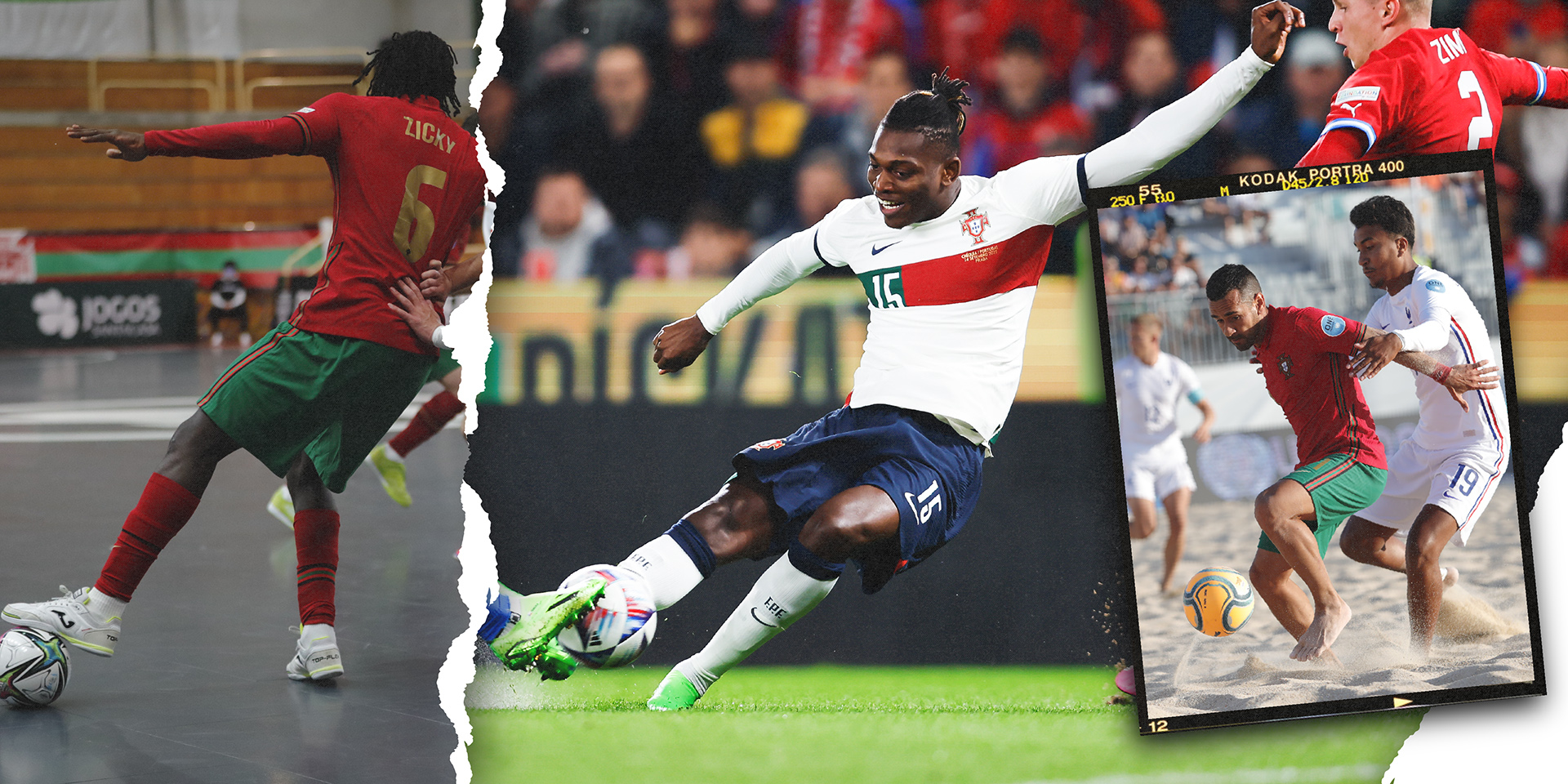
Whether on grass, in the gym, or on the sand, the love for playing with a ball is universal. However, despite sharing the same essence, Football, Futsal, and Beach Football each have their own rules, dimensions, and very distinct characteristics.
For a long time, Futsal and Beach Football were seen as mere variations of Football. Today, with official recognition by FIFA, each has the status of an independent sport.
So, what are the main differences between football and futsal, and how does Beach Football also set itself apart?
Traditional Football is played on natural or synthetic grass fields that can vary between 90x45 meters and 120x90 meters.
Futsal, on the other hand, is played indoors, usually on wooden or synthetic floors, with fixed dimensions of 40x20 meters.
Beach Football is played on sand fields, which are smaller—between 35 and 37 meters in length and between 26 and 28 meters in width—with a minimum sand depth of 40 centimeters.
These differences in playing surfaces deeply influence the style of play. Grass favors endurance and long ball circulation, indoor courts demand speed and agility, while sand limits movement, requiring greater creativity and acrobatic ability.
The duration also varies considerably. In Football, matches consist of two halves of 45 running minutes with a 15-minute halftime.
In Futsal, games have two halves of 20 timed minutes, with the clock stopping at every interruption, making the pace more intense and physically demanding.
In Beach Football, game time is even shorter: three periods of 12 timed minutes, separated by short three-minute breaks.
In practice, this means that Football emphasizes endurance, Futsal focuses on intensity, and Beach Football delivers fast paced and unpredictable entertainment.
Another key difference is the number of players. Traditional Football is played with eleven athletes per team, allowing for a wider variety of tactical systems and specific roles on the field.
Futsal and Beach Football, on the other hand, are played with only five players per team, including the goalkeeper.
This reduced number of players creates more dynamic games with more frequent scoring opportunities, especially in Futsal and Beach Football, where goals often happen more regularly.
The ball is another distinguishing factor. In Football and Beach Football, the circumference is around 68 to 70 centimeters. In Futsal, the ball is slightly smaller, between 62 and 64 centimeters, with a reduced bounce to adapt to the hard floor and limited space of the court.
This difference may seem minor, but it completely changes how the game is played. A low-bounce ball allows for greater control in tight spaces, while in Football and Beach Football, the lighter, bouncier ball favors long passes and powerful shots.
In Football, substitutions are limited and irreversible, usually three to five depending on the competition. In both Futsal and Beach Football, substitutions are unlimited, and players can return to the game after being subbed out, which keeps the intensity high throughout the match.
Futsal also has a five-foul rule per half: starting from the sixth foul, the opposing team is awarded a direct free kick from the ten-meter mark.
In Beach Football, ties are not allowed. If the game ends in a draw, a three-minute overtime is played, and if necessary, penalty kicks decide the winner.
Another significant difference lies in red cards: when a player is sent off, the team must play for two minutes with one fewer player, or until they concede a goal, something that doesn’t exist in the other two sports.
From a technical standpoint, Futsal emphasizes ball control with the sole of the foot, short dribbles, and toe-poke shots. Football, on the other hand, focuses on long passes, wider dribbles, and shots with the instep.
Tactically, Futsal has developed specific systems like the 2-2, 3-1, or 4-0, designed for the smaller playing area and the need for fast ball circulation.
Football, due to the larger field and higher number of players, offers much greater tactical variety, ranging from the classic 4-4-2 and 4-3-3 to more modern approaches like the 3-5-2 or the 4-1-2-1.
On sand, everything is more unpredictable. Receiving the ball often requires lofted passes, chest or thigh control, and acrobatic shots like bicycle kicks, which have become a hallmark of the sport.
Tactics are simple and adaptable: the 2-2 is the most balanced, the 3-1 is used when protecting a lead, and the 1-3 is adopted when chasing the score.
A unique feature is the goalkeeper’s role—not only defending but also actively participating in attack, sometimes even taking shots on goal.
All three sports share the same origin but have evolved in different ways. Football is the most complete in terms of physical and tactical complexity; Futsal demands quicker thinking and refined technical skills in tight spaces; while Beach Football combines creativity, stamina, and spectacular moves.
Regardless of preference, all three provide excitement, competition, and the same passion: playing with the ball.