

Your cart is currently empty.
Discover our products.
6 February 2023
The first edition of the World Cup took place in 1930 in Uruguay, while the European Championships only came to life in 1960.
Despite the numerous editions of both competitions throughout the 20th century, the Portuguese only had the honor of seeing their national team in a major tournament at the 1966 World Cup, the 1984 Euro, and the 1996 Euro.
With the arrival of the 21st century, everything changed. Based on a strategy that prioritized youth development, the Portuguese Football Federation (FPF) laid the groundwork for uninterrupted qualifications from 2000 onwards and the successive rise of great generations of players who proudly wore the national team’s kit.
Since 2000, every two years, we’ve been able to pull the Portuguese national team jersey out of the closet and cheer for their performances on the world’s biggest stages.
But the match kit that fans wear on the streets doesn’t always match the official one Portugal wears at the World Cup or European Championship.
Green and red are eternal, but every two years, there are changes. In this article, we’ll take you through all the transformations in Portugal’s match kits over the past 20 years. Let’s begin with the 2002 World Cup in South Korea and Japan.
Led by coach António Oliveira and captained by Fernando Couto, the national team took part in the 2002 World Cup.
Portugal exited in the group stage after defeats to the United States and South Korea and a victory over Poland. Despite having alternative kits, in all three matches Portugal wore their primary kit, which, except for the addition of green details on the jersey, was very similar to the one used at Euro 2000.
The occasion deserved a kit worthy of hosting a major competition. In this European Championship, where we dressed our bodies, streets, and homes in national colors, the match kit was immortalized by a bright red jersey with yellow numbers circled in yellow, giving it a cheerful look—until Greece spoiled the party.
After the memorable Euro at home, Portugal traveled to Germany with a suitcase full of dreams and kits full of personality. The bright red of Euro 2004 was replaced by a more sober shade of red which, for the first time, was also used entirely on the shorts.
In addition to the 4th place finish—Portugal’s second-best World Cup performance—the alternative all-black match kit stuck in everyone’s memory.
The all-red match kit was retained but gained more vibrancy, with green accents on the sides of the jersey, reminiscent of the 2002 kits. The alternative kit also saw changes: the all-black was replaced by an all-white version with a red collar and green details on the jersey, shorts, and socks.
Africa’s color and joy spilled over into Portugal’s kits. The main kit was only used in the unforgettable 7-0 victory over North Korea. This all-red match kit stood out with two green horizontal stripes—one across the chest covering the FPF badge, and another on the socks.
Against Ivory Coast (group stage) and Spain (round of 16), the alternative match kit was chosen: a white jersey with a vertical red and green stripe down the middle, green shorts, and white socks with green stripes. Against Brazil, Portugal wore the red jersey with white shorts and green socks.
Portugal entered Euro 2012 with an all-red match kit featuring only green accents on the collar and socks, accompanied by a green polo for off-field wear.
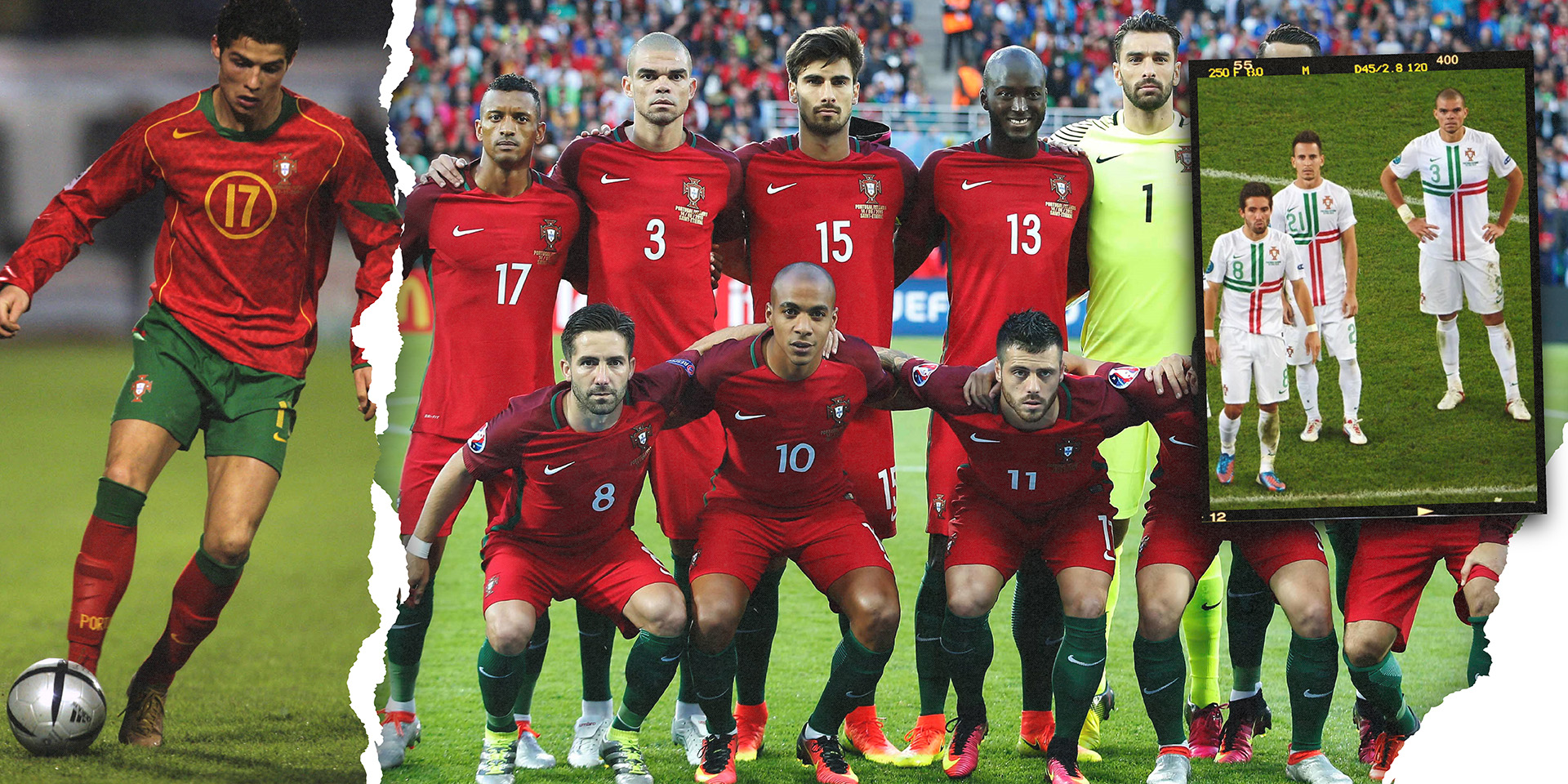
After the group stage, this match kit was replaced in the knockout rounds. Against the Czech Republic and Spain, Portugal wore the alternative all-white match kit featuring a stylized red and green cross across the chest.
The United States, Germany, and Ghana stood in the way of Portugal’s World Cup dreams in Brazil. To face them, Portugal wore an all-red match kit highlighted by a jersey with stripes in different shades of red.
Although never used in the tournament, the alternative match kit was a beautiful throwback: a white jersey with blue shorts, reminiscent of the team’s earliest match kits from the first half of the 20th century.
The unforgettable summer of 2016 will always be remembered for Éder’s phenomenal strike in the final against France, crowning Portugal European Champions for the first time.
The main match kit used in that historic moment featured red with green accents—on the socks and as a vertical stripe running from the jersey to the shorts.
In the semifinal against Wales, Portugal wore the secondary match kit, swapping white for an aqua-green shade.
Red jerseys and shorts (without the green stripe) paired with green socks starred in Portugal’s 2018 World Cup campaign.
Used in the opener against Spain, this match kit was replaced in subsequent games by the all-white alternative with red numbers—against Morocco and Uruguay, the latter being the match that eliminated Portugal in the round of 16.
Four matches, two match kits. For their sixth consecutive European Championship and eighth overall, Portugal debuted against Hungary in the iconic alternative match kit: a green base with three red and green horizontal stripes across the jersey.
For matches against Germany and France, the team returned to the main match kit: red jersey and socks, paired with green shorts.
For a disruptive World Cup, a disruptive match kit. Against Ghana, Uruguay, and Switzerland, Portugal wore their main match kit, which drew attention for its bold design—a diagonal division splitting the jersey into red and green, paired with green shorts and red socks.
Against South Korea and Morocco, the alternative match kit was worn: a white jersey with a horizontal red and green stripe across the chest.
Over these 20 years, the Portuguese national team’s match kits have been more than just sportswear: they have become symbols of generations, triumphs, and unforgettable moments in Portuguese collective memory.
From sober reds to bold new designs, each jersey told a story, accompanying us through victories, defeats, and, above all, the unwavering passion for Portugal.