

Your cart is currently empty.
Discover our products.
3 April 2025
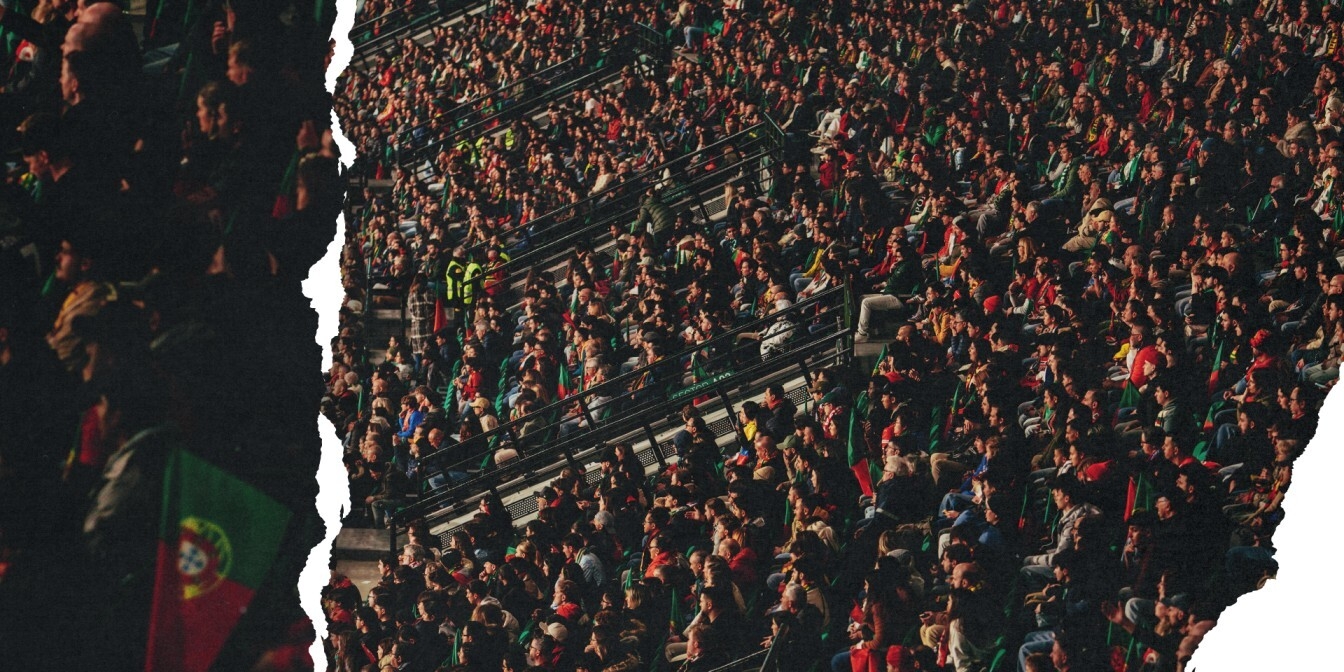
While the fate of teams is decided on the pitch, it is in the stands that emotion and drama intertwine in the hearts of fans.
The stadium is, therefore, a true Greek theater where football’s greatest tragedies and, sometimes, its most ironic comedies unfold.
It's easy to rewind time and nostalgically recall that Portugal vs. Republic of Ireland match on a rainy November day in 1995, when our national team reconciled with history and secured a resounding 3-0 victory to qualify for its first major tournament since the 1986 World Cup.
That day, in the stands of Estádio da Luz, more than 71,000 spectators dressed in red and green supported, suffered, and ultimately celebrated through tears and smiles of joy when the referee's whistle sent our team to the 1996 European Championship.
Fortunately, Portugal’s stadiums are rich in such stories—stories that we will now uncover.
From Largo da Achada in Camacha, Madeira—where, in 1875, the first recorded football match in Portugal took place—to the modern, high-tech stadiums of the 21st century, history has provided countless moments that helped shape Portuguese fans' passion for the game.
In this regard, it is impossible not to mention Estádio da Luz, Estádio de Alvalade, and Estádio do Dragão/Antas, but if there is one place where the concept of a football temple has truly taken root, it is in the monumental Estádio Nacional.
After much debate, the need to equip Portugal with a world-class stadium (for its time) led to the construction and inauguration of Estádio Nacional on June 10, 1944.
To celebrate the occasion, Sporting and Benfica were invited to play a match that was worth not one but two trophies: the Taça Império, sponsored by the Portuguese Football Federation (FPF) and considered a prototype of the future Supertaça Cândido de Oliveira, and the Taça Estádio, a trophy offered by Salazar’s dictatorship to commemorate the event.
The match ended 3-2 in favor of Sporting, but the history of Jamor was just beginning.
Three years later, on May 15, 1947, the stadium witnessed Portugal's worst-ever defeat, a 10-0 loss to England, immortalizing the phrase: “That wasn’t a match; it was... ten in a row.”
As the official home of the Portuguese national team, the stadium has hosted many glorious moments, but it is as the stage for Portugal’s premier cup competition that Estádio Nacional has earned a special place in fans' hearts. Every year, supporters dream of seeing their team reach the final and celebrating in the stands and surrounding woodlands of Jamor.
Besides the Portuguese, Celtic fans from Scotland also hold Jamor dear, as it was here that they won their only European Cup title in 1967, defeating Inter Milan.
From the triumphs of Benfica legends Eusébio and Coluna to historic victories by the national team, Estádio da Luz (both the old and the new) is synonymous with dreams coming true.
Inaugurated on December 1, 1954, the old Estádio da Luz, with an official capacity of 120,000 spectators, saw Portugal qualify for Euro '84 when Chalana won a decisive penalty against the Soviet Union. Years later, Rui Costa’s brilliant goal paved the way for qualification to Euro '96.
The new Estádio da Luz had a rocky start, hosting Portugal’s loss to Greece in the Euro 2004 final, but since then, it has been the stage for several successful qualification campaigns for European Championships and World Cups.
On the club level, the stadium hosted two UEFA Champions League finals, in 2014 and 2020, crowning Real Madrid and Bayern Munich as European champions.
Like Estádio da Luz, Estádio de Alvalade has two eras: one before 2003 and another starting with Euro 2004.
Inaugurated on June 10, 1956, the old stadium was the first in Portugal to host a televised match. On February 9, 1958, Sporting defeated Austria Vienna 4-0 in a friendly.
After decades of titles and legendary matches, the old stadium was replaced by Estádio José Alvalade, Portugal’s first UEFA five-star stadium.
Notable moments include Cristiano Ronaldo and Maniche's performances against Spain and the Netherlands in Euro 2004 and historic wins over Russia and Belgium.
After decades of playing in temporary venues, FC Porto moved into Estádio das Antas in 1952. It took until 1978 for Porto to reclaim the national championship, but from then on, the stadium became a fortress.
Besides domestic success, Antas hosted celebrations for Porto’s European triumph in 1987, as well as victories in the UEFA Super Cup and Intercontinental Cup. The stadium also hosted the national team’s memorable 2-1 win over Brazil in 2003.
With the opening of Estádio do Dragão, Porto gained a modern venue that witnessed Portugal's Nations League victory in 2019 and record-breaking attendance for women's football in 2024.
Portugal's stadiums have evolved, offering fans greater comfort, albeit with reduced capacities. The top 10 largest stadiums are:
Estádio da Luz - 65,592 seats
Estádio José Alvalade - 50,095 seats
Estádio do Dragão - 50,033 seats
Estádio Nacional - 37,593 seats
Estádio Municipal de Aveiro - 32,830 seats
Estádio Algarve - 30,305 seats
Estádio Municipal de Braga - 30,286 seats
Estádio D. Afonso Henriques - 30,029 seats
Estádio Cidade de Coimbra - 29,622 seats
Estádio do Bessa XXI - 28,263 seats
With Estádio Nacional undergoing renovations to become a state-of-the-art venue, Portugal’s major stadiums will undergo transformations for the 2030 FIFA World Cup, co-hosted with Spain and Morocco.
Estádio da Luz, Estádio de Alvalade, and Estádio do Dragão will be upgraded to welcome fans from around the world, setting the stage for unforgettable matches and, perhaps, Portugal’s long-awaited World Cup triumph.